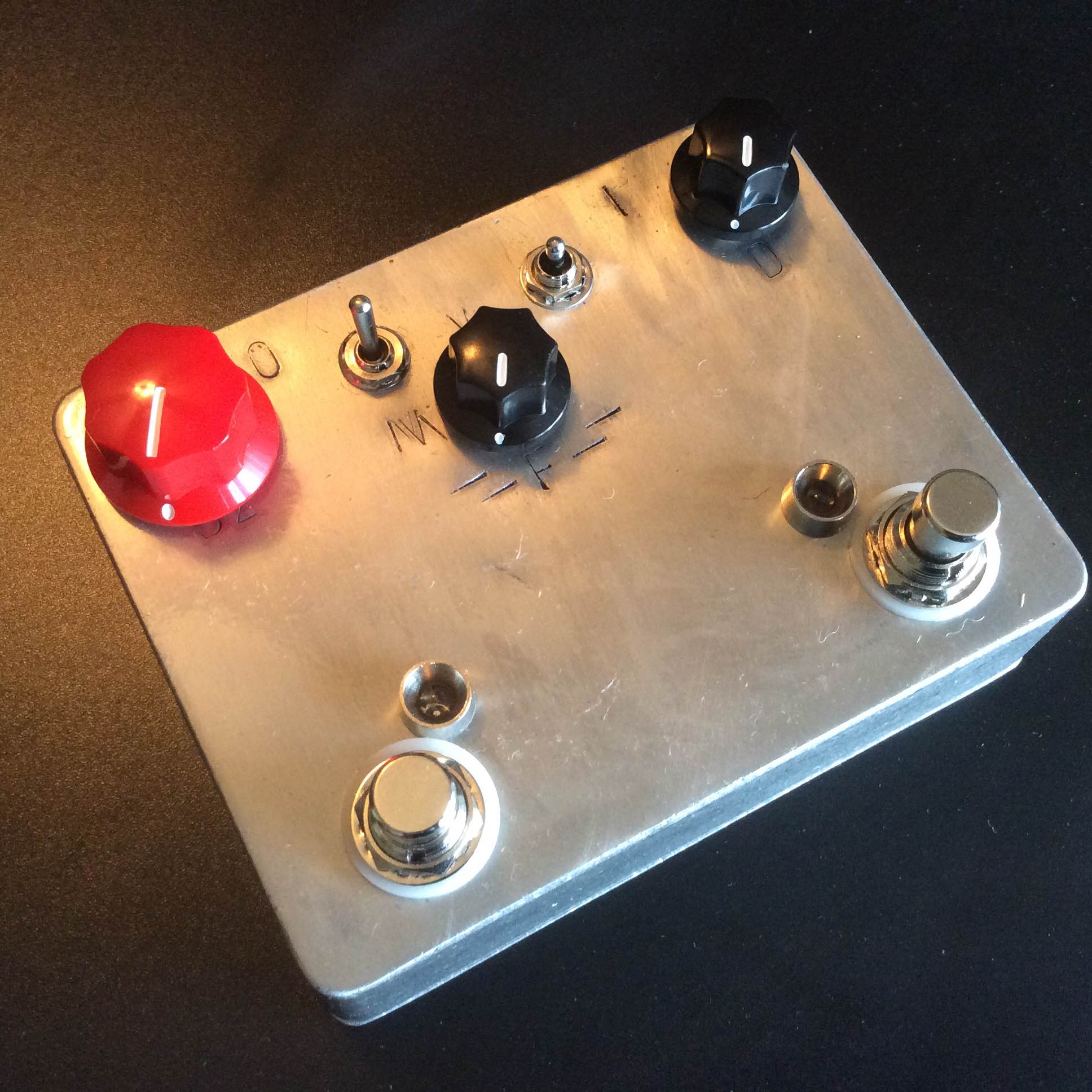
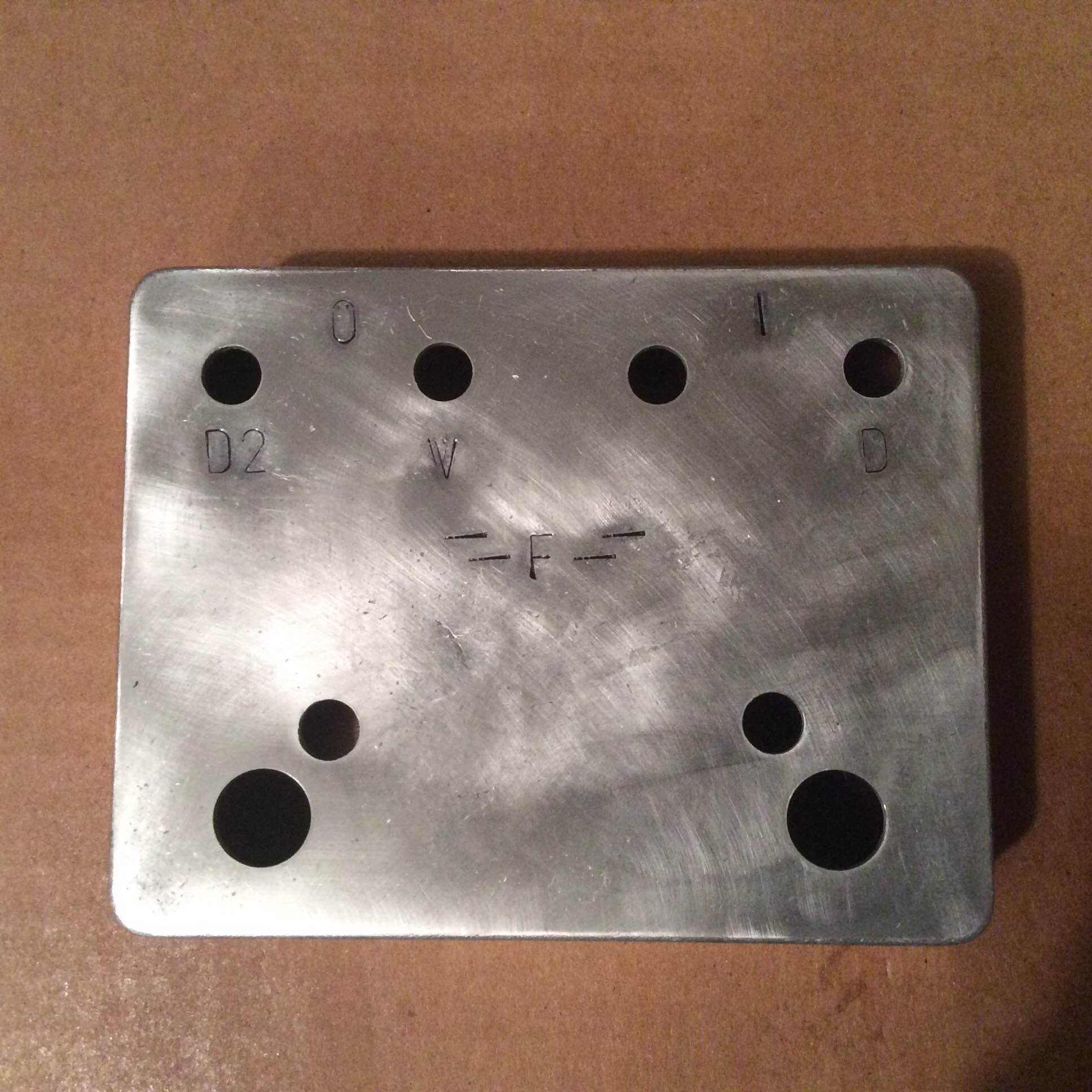
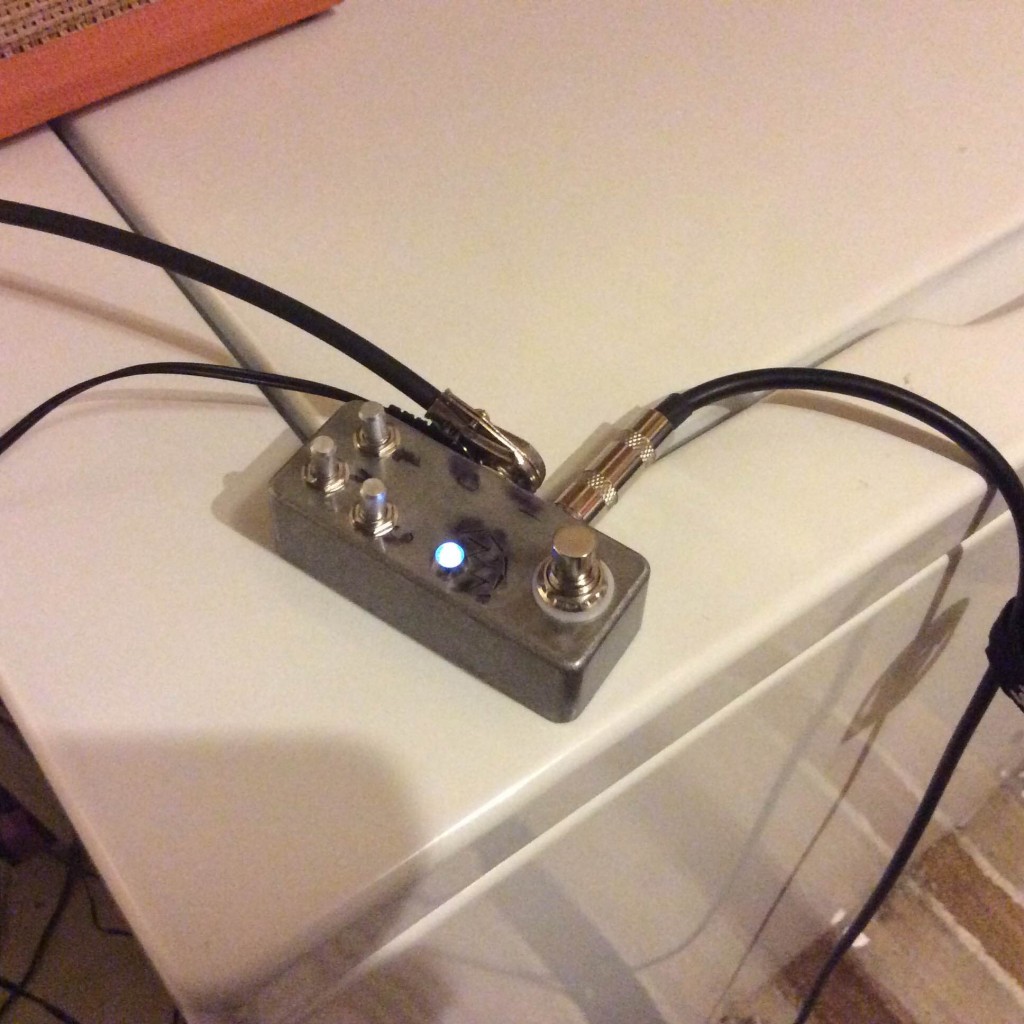
The “D2” label will be moved down for future units, of course. I wasn’t thinking about over-sized knobs when I stamped this first enclosure.
“M” will become “M2” (since the mids switch is only available when the D2 channel is engaged) and the unlabeled switch probably needs a “C” for clipping.
Sounds righteous, nonetheless! Psyched to get it integrated into my Mars Lights rig.
I figure the main channel will replace my VFE Triumvirate for always-on boost & slight clipping duties, and channel 2 will replace the EHX Bass Big Muff Pi for heavy parts. I still love those pedals, this will just free them up for other uses, probably recording for the Triumvirate (where its flexibility really shines) and maybe suuuuuuuuuper-heavy parts for the Muff.
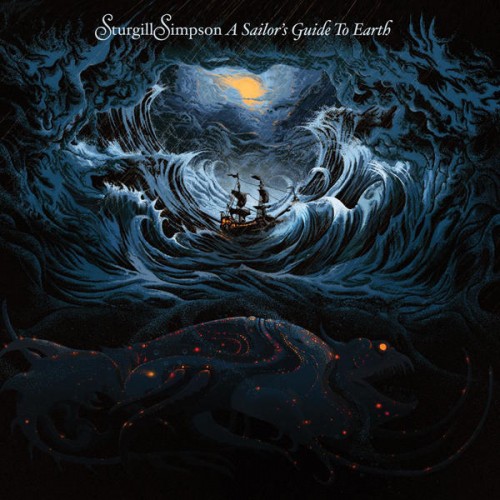
It’s a wonderful left turn of a record, released when fans and critics would have welcomed a Metamodern Sounds pt. II. Self-produced, it sounds clear, warm, and open, the Dap-Kings’ soulful horns swirling chocolate-and-peanut-butter-like with Simpson’s brand of slacker psychadelic outlaw country.
Sturgill’s been open about A Sailor’s Guide… being a song cycle written for his family, especially his first child who was born just as his career took off. What he hasn’t said – and there’s a tantalizing hint in the Maron interview about this – is just how deep the concept goes. I think the album is sequenced chronologically beginning with a father singing a song to his newborn son and continuing as the son grows up, maybe having a child of his own.
“Welcome to Earth (Pollywog)” is sung to a newborn
“Breakers Roar” comforts a young child
“Keep it Between the Lines” offers advice to a teen
“Sea Stories” finds a father and his young adult child developing a more mature relationship
“In Bloom” (Nirvana cover)
“Brace for Impact (Live a Little”) reminds a thirty-something child that life can be short, and it should be fun
“All Around You” illustrates a deep connection, only able to be seen through long experience, with a child who is now old enough to have felt real pain
“Oh Sarah” shifts the spotlight to the steady partner whose presence has been felt, but not addressed directly, throughout the record
“Call To Arms” – The old man’s got nothing to lose and speaks his mind (not that he hasn’t always), turning from his family outward toward the world
“In Bloom” is the outlier here, thematically and musically. As it sits in the center of the sequence it strikes me as meaningful, though I’m not entirely sure what to make of it. It’s, for me, the weak point on the record musically as Simpson drops half of the chord sequence from the verse, rendering the tension of the original toothless.
Maybe changing Nirvana’s rager into a lullaby illustrates a father nostalgic for his younger child while simultaneously recognizing the adult he’s become. Or maybe I’m reaching. But the rest of the album makes so much sense – six songs of a child growing up, followed by two turning progressively outward to others – I need a way to understand the intent here.
Simpson can obviously write incisive, vivid lyrics when he wants to. That this record also features some fairly worn cliches struck me as odd at first, though they’re wearing alright with time. Sometimes the language of love and family is what’s comfortable and familiar, said a thousand times and no less true for it.
MR|Review directs readers’ limited attention among works via ratings, and within works via prose, focusing on works where our opinion diverges from critical or popular consensus, or we have significant insight that compliments or challenges readers’ aesthetic experience.
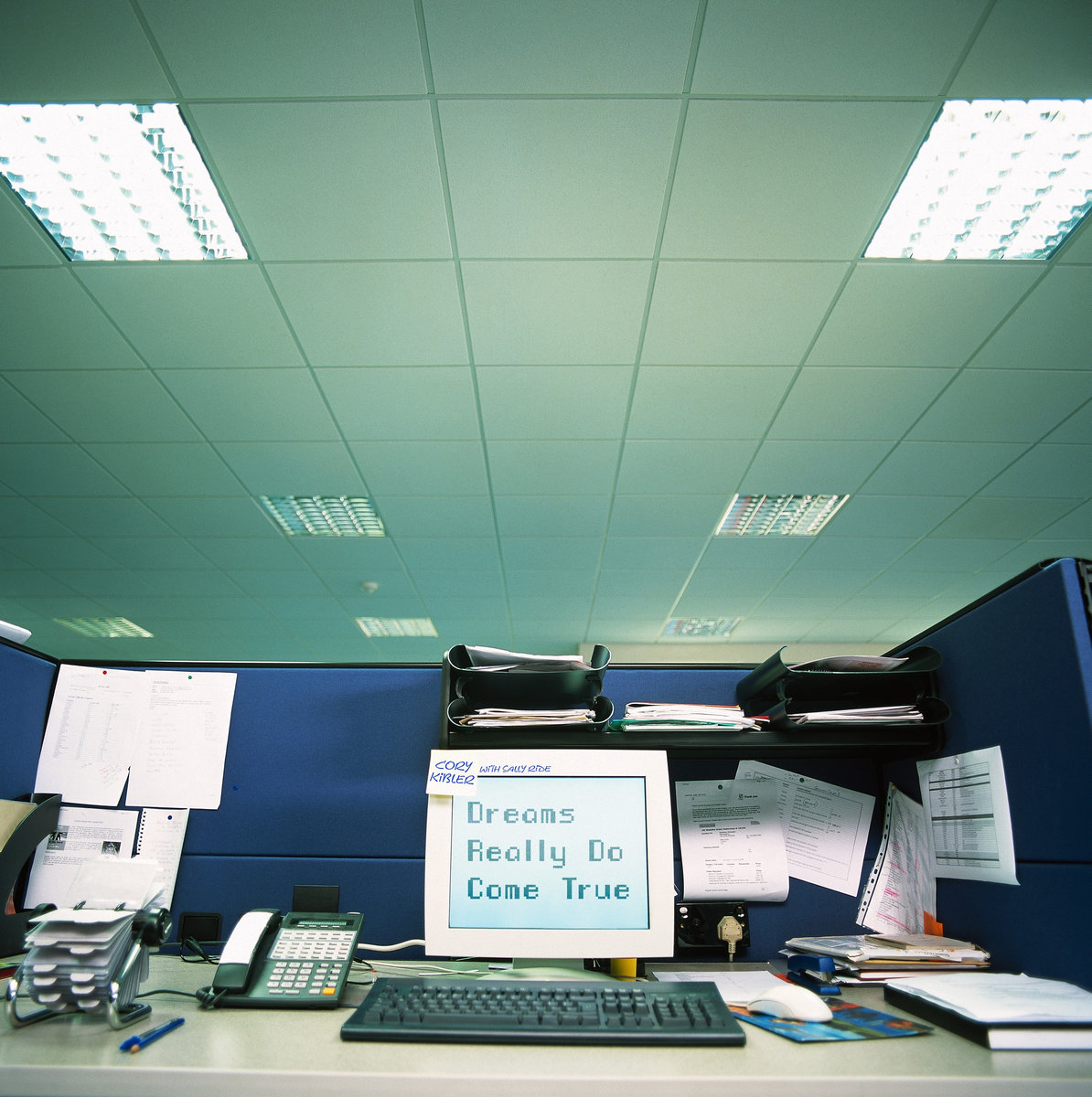
In the back of the blog topic file I found a question from Jill; why is Ventura called “Ventura,” and is it because of Cory?
It is, but I don’t remember why exactly.
The collection of songs was gathered together under the name “Ventura” prior to my one visit there with him in 2006, almost certainly prior to even planning that trip.
At some point early on the east-to-west movement that connected those first few songs became apparent. With the Pacific as the end point of this twenty-something punk symphony to leaving home and growing up, Ventura could stand in for a more mythic place of serenity. It’s a milestone from which to look back on the journey so far, and prepare for the one ahead.
Plus, it’s a cool-sounding, lesser-known California town. I certainly wouldn’t have known its name without knowing Cory.
Ventura, California’s relationship to Ventura is more concrete than Dodge City Kansas’ is to You Have To Wear The Boots’ Dodge, but there’s a symbolic similarity too.
Made this yesterday to house the first Falcon Drive.
I have an idea how to improve the =F= design a bit, but this is pretty much the idea. This will be the demo unit and ultimately go on my board, unless someone has a hankering for serial #0001.
Dark Satellites’ Be Still vinyl is available for pre-order on Bandcamp (click “Buy” below) (you can stream the whole thing, too).
Drew has made an incredibly good record. It’s catchier, it’s heavier, and it’s synth-ier than 2012 Are Here.
If it matters to you, I played drums on “Strange Song,” bass on “Just Dropped Out,” and mastered the album. This is the first thing I’ve ever contributed to that’s been pressed to wax!
The vinyl is a cool gray and taupe splatter to match the cover art, and we should receive it in June. $25 shipped to the lower 48. Drew will break even when every record is sold, basically; we will not profit on this. It is the definition of a labor of love.
This morning I finished the design for a new pedal, the Falcon Drive. I’ll be taking reservations for a small run of them soon.
There it is on the breadboard. Doesn’t look like much, maybe, but it’ll do a nice JFET mostly-clean boost (slight compression, fatness, & edge on the pick attack; nice!), an asymmetric MOSFET/LED overdrive, and a scuzzy Schottky diode drive.
The finished enclosures will be laid out like this, with Kingman-style stamping and finishing. The second footswitch, LED, and colored knob are for a second gain/saturation preset.
True bypass, quiet switching, extremely high (10M) input impedance and low (3.3K) output impedance are featured to preserve treble and drive long cables. The Falcon has a huge range of useable gain; I love it for everything from always-on unity gain buffer to dimed out.
Video coming soon-ish. Before the reservations are closed, for sure, so you can decide if you (or the guitarist in your life) need one!
Over the past two weekends I’ve made progress on my first run of six Kingman pedals, and have finished the first two. I know #0002, the one I’m keeping, will go into immediate use as Mars Lights continues to record our double LP.
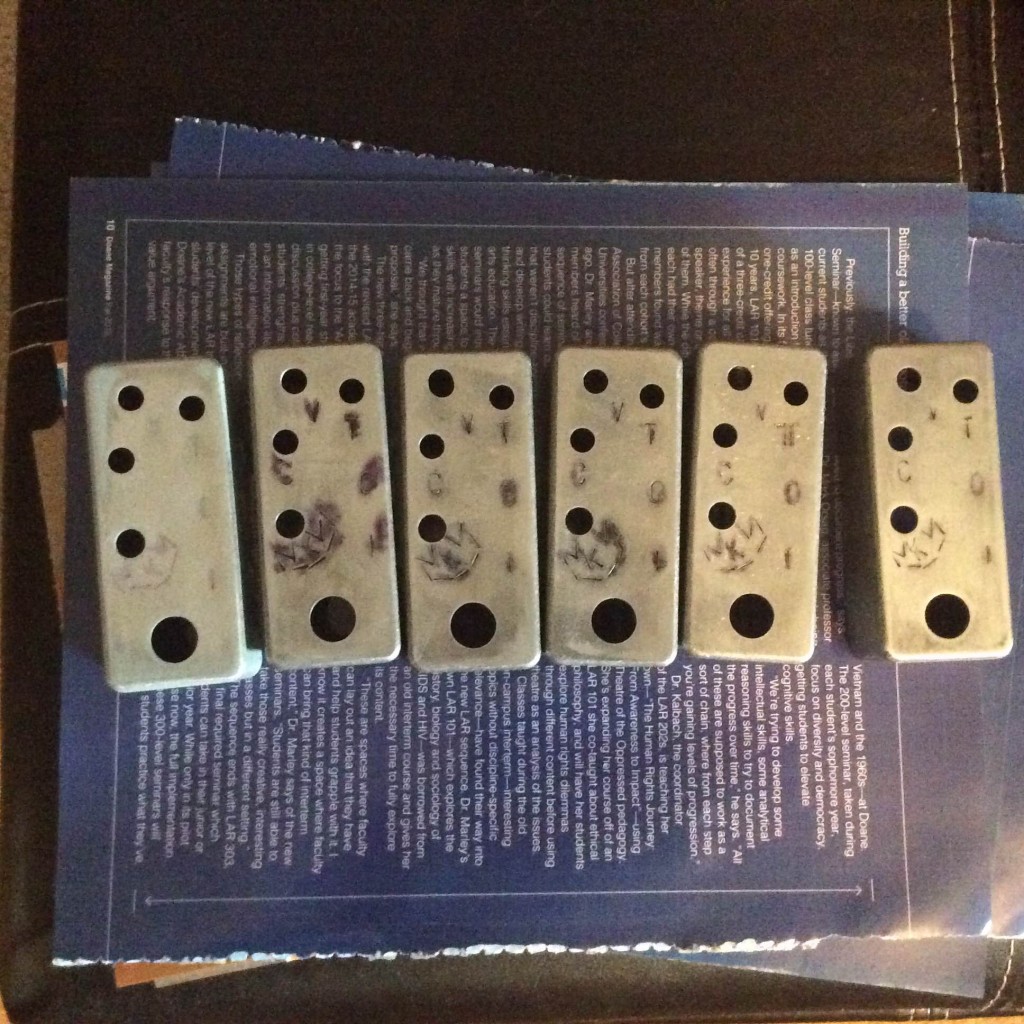
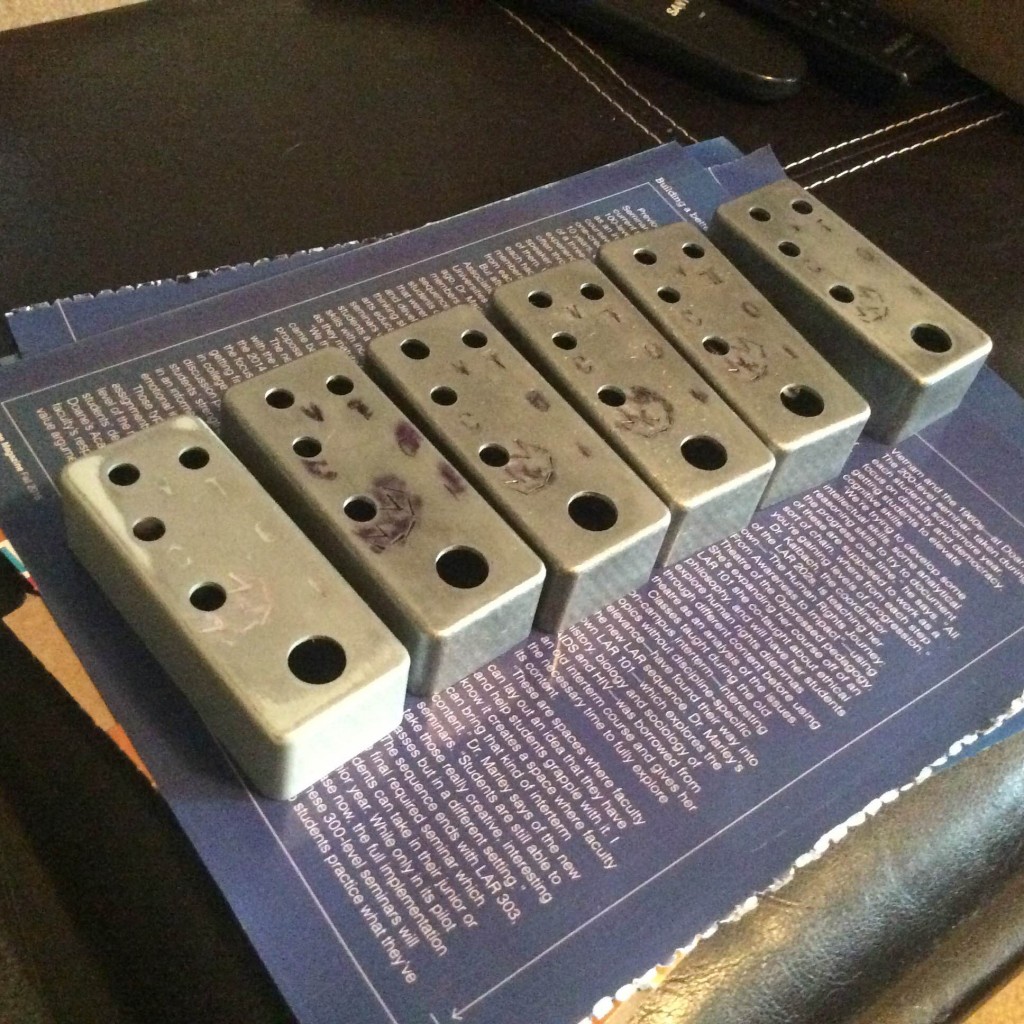
Last weekend was given over to figuring out how to finish the enclosures. I tried various combinations of paint, stamping, Sharpie, dry sanding, wet sanding, and clear coating.
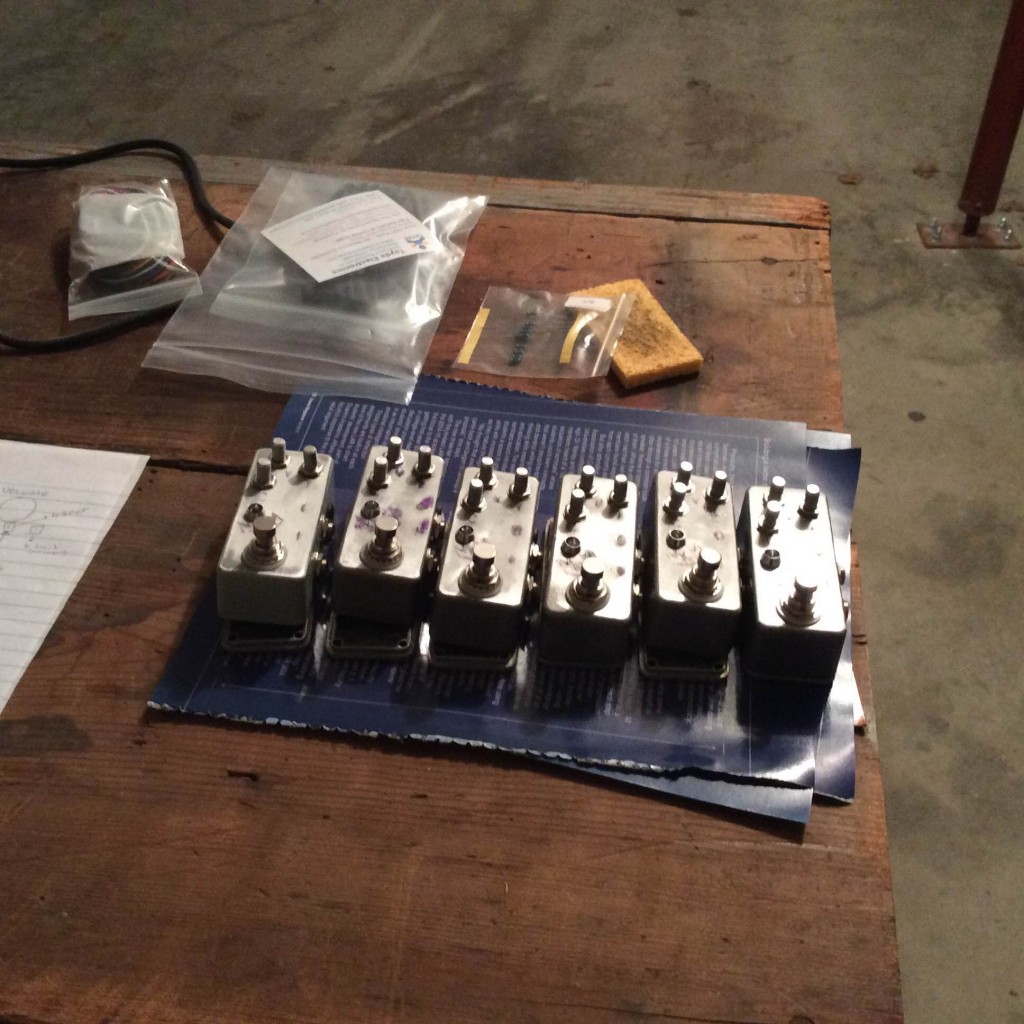
Finished enclosures #0001-0006, left to right
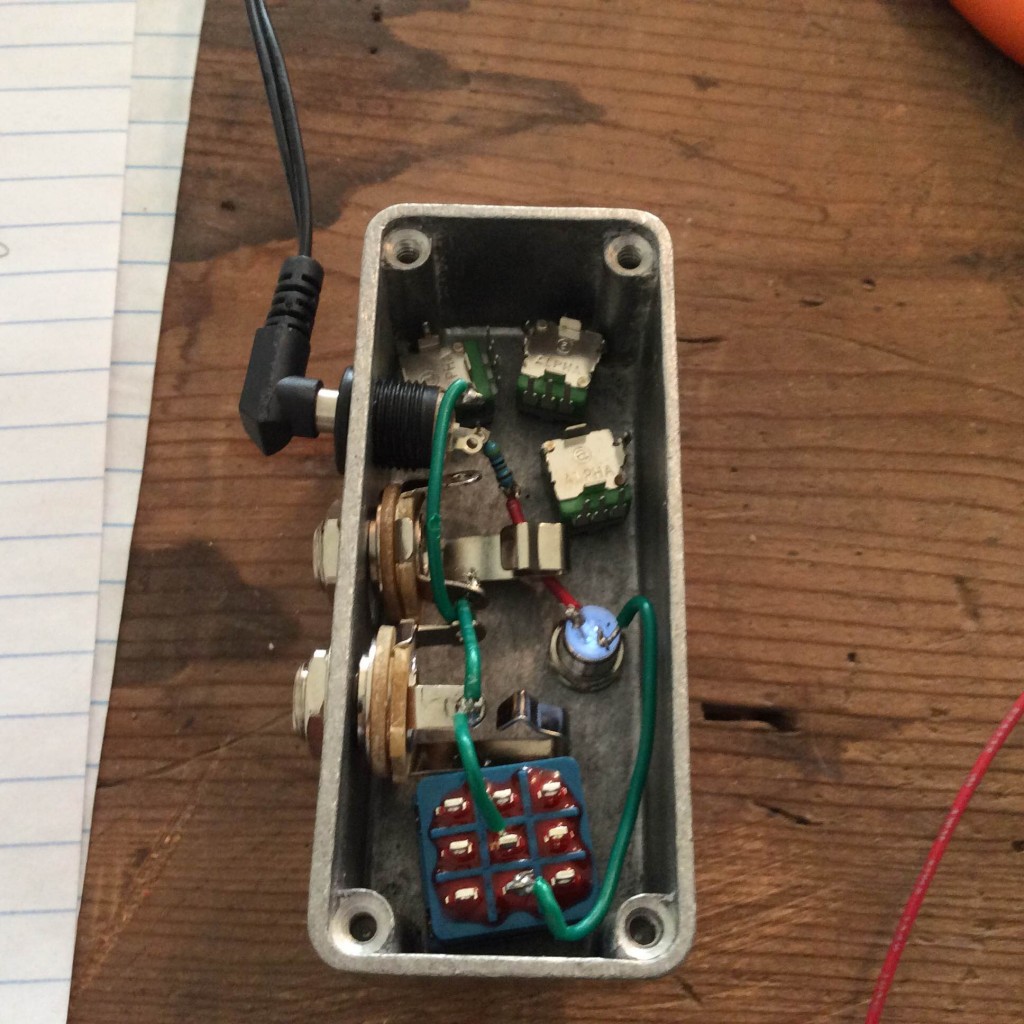
Simple as the Kingman circuit is, there’s no circuit board; just parts mounted to the enclosure, point-to-point wiring, and two capacitors.
Dry-fitting jacks, switch, LED, and potentiometers
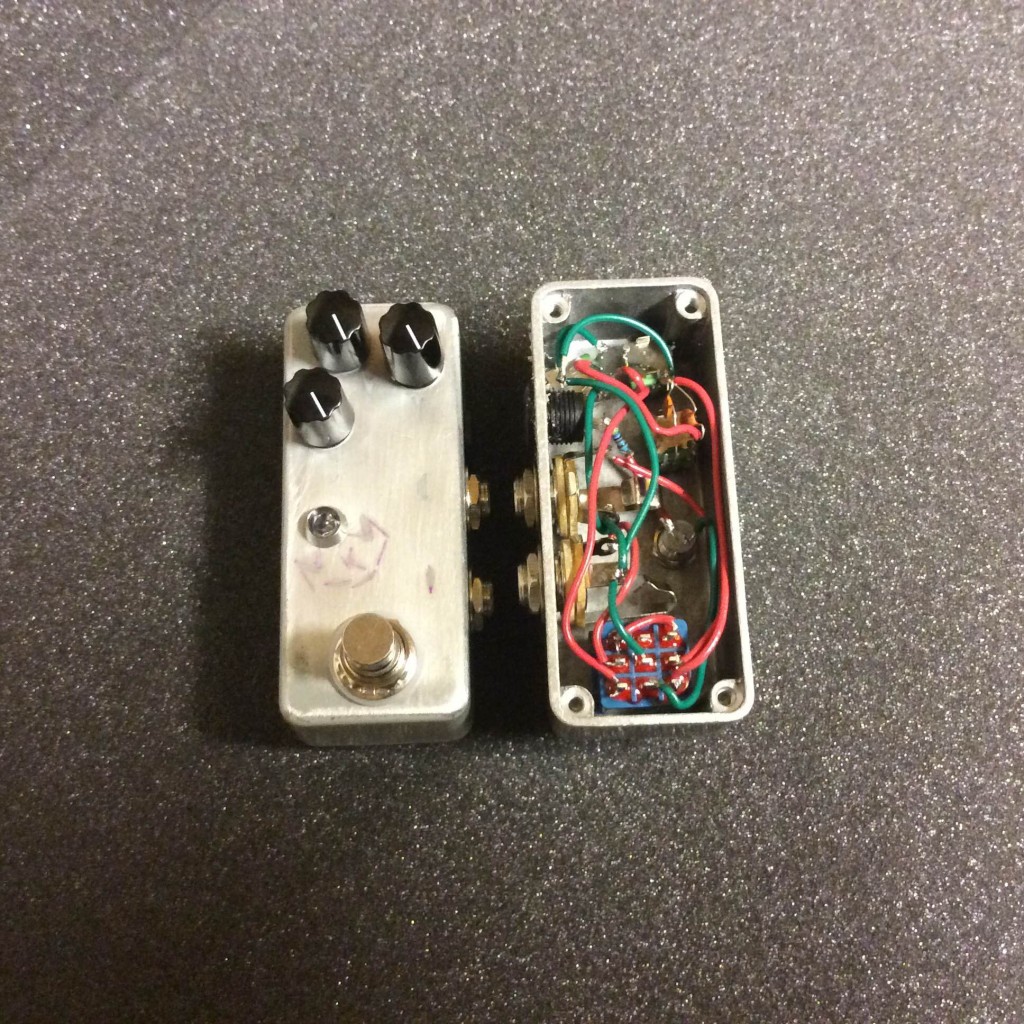
Yesterday I started wiring. It’s not the prettiest but the connections are solid and it gets the job done. No one can hear my wiring!
#0002 with its LED working
The first one took two and a half hours, but it worked on the first try. I consider that a win.
#0002 alive and kicking!
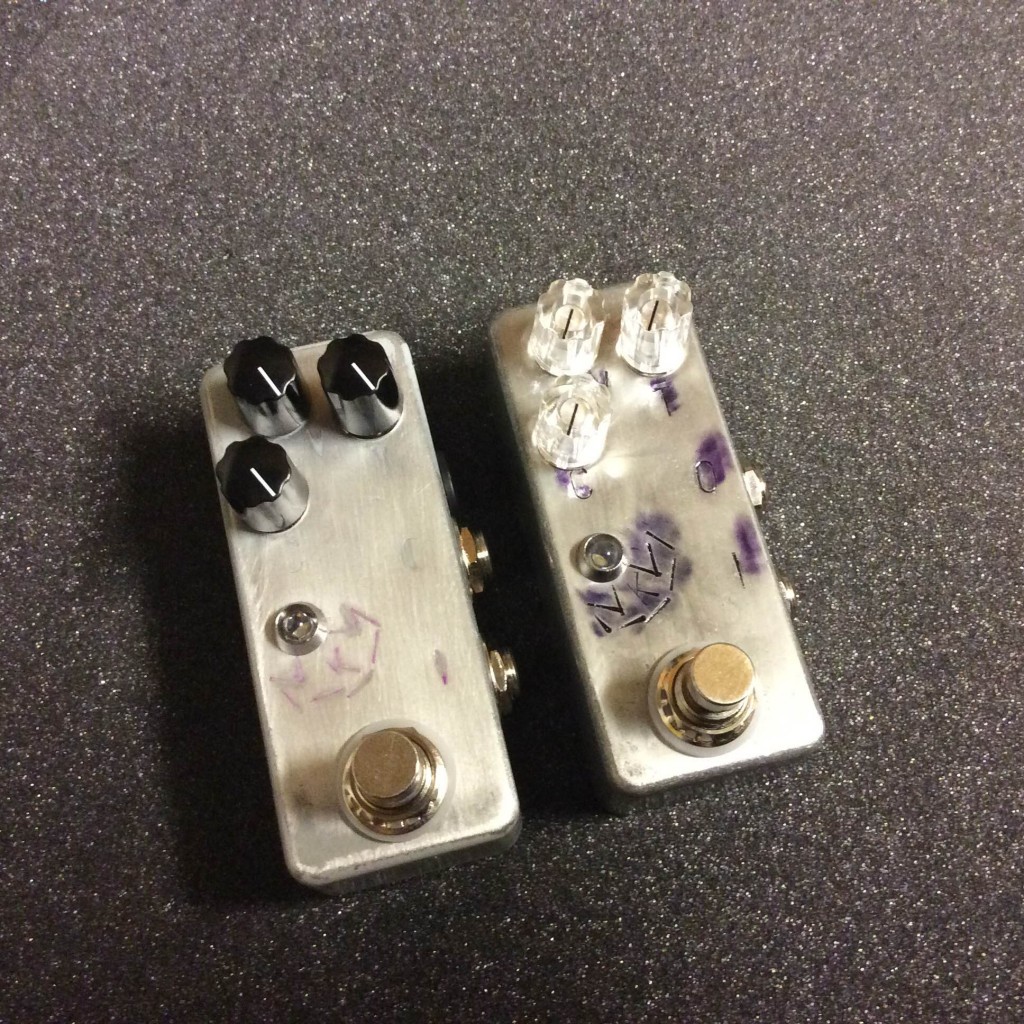
After getting #0002 running (I numbered based on the enclosures. Wanted to do something special with #0001 and thought it would benefit from me making and correcting any wiring mistakes on my own) I wired #0001 up today. #0001 is the only enclosure I painted and will be the only one with black knobs. Future Kingmen will look more like #0002 with the clear knobs, but without the purple smears. I learned how to fix that, but thought that since purple is a royal color I would leave mine with the weird blurs.
Brothers #0001 (left) and #0002
Like I said, not the prettiest at all. Neither were a lot of great-sounding vintage pedals! I appreciate today’s beautiful PCB and wiring jobs as much as the next guitar player, but they’re not necessary for a circuit to do its job.
Gut shot of #0002
What have I learned?
How to finish enclosures in a unique way. None of these first six are exactly how I plan to do them in the future; I learned how to avoid the smearing you see on #0002 (and to a lesser extent on subsequent ones) as I did the very last step. Future boxes will look similar to #0006 but even cleaner around the stamps.
Stuffing PCBs is a very small part of making a pedal! Honestly if the Kingman had a PCB with 20 components, it would only add maybe an hour or less to the 3 1/2 – 4 hours of labor I put into each of these pedals. I imagine I’ll get faster over time, but there are limits.
Stamping is tricky. Got to hit the stamp (not one’s fingers) square, hard, and on the intersection of any lines (such as where the three lines of a “K” meet).
I’m proud of fitting the input and output jacks on the same side of a mini enclosure, saving players’ pedal board space
I’m not done with this run – four more wiring jobs to do – but I’d do it again, and plan to.